

With approximately 42,000 SaaS companies worldwide, it has become more difficult than ever to stand out. Although no SaaS startup wants to be overlooked, in a highly crowded market, that is sometimes the case. Now you must be wondering what you can do to cut through the noise, right? The answer is to implement effective SaaS PR.
By creating and implementing effective public relations strategies, SaaS companies can not only establish brand credibility but also enhance brand visibility and accelerate their business growth by transforming technical products into industry-leading narratives.
Looking to learn more about SaaS public relations and how it can benefit your company? Then this blog is for you. It will provide a complete overview of public relations for SaaS companies and why, and a comprehensive guide to developing an effective PR strategy for SaaS startups as well as established SaaS companies. So, ready to get started?
What is SaaS Public Relations?
Before we move on to the benefits and steps to create a PR strategy, let’s first understand what PR means for SaaS companies.
So, public relations for SaaS companies is the strategic process used by cloud-based software companies to establish brand visibility, credibility, and trust among target audiences through thought leadership, earned media, and effective reputation management.
Unlike traditional PR, SaaS public relations focuses on key metrics such as category differentiation, qualified leads, and Monthly Recurring Revenue (MRR) growth to stand out in the highly competitive market.
Why Public Relations is Crucial for SaaS Providers
There are several ways in which public relations is crucial for cloud-based software businesses. In this section of the blog, we have discussed a few of them –
- Offers Higher Brand Visibility
Suppose you have created an advanced SaaS product like a CRM software that can streamline business growth. But without enough brand visibility, your product will remain unknown to your audience.
By developing an effective PR strategy, SaaS companies can create engaging stories about their brand and pitch them to the media. Not only that, but through informative press releases, interviews with the media, and publishing thought leadership articles,SaaS companies can enhance their brand presence online.
- Builds Trust and Credibility
Trust and credibility are the two most important factors in the SaaS industry. When prospective customers come across a new brand, they are likely to feel skeptical. Customers want to know whether or not your products are reliable and deliver what they promise.
By leveraging third-party endorsements like media coverage, SaaS businesses can add credibility to their claims. Furthermore, sharing success stories from happy customers can foster trust among prospective customers.
- Attracts More Investors and Fundings
Attracting investors and securing funding is very important for SaaS startups that are looking to scale and expand. However, investors are often very careful and selective where they put their money. They seek SaaS companies that have proven their worth and showcase growth potential.
An exceptional SaaS PR strategy can make SaaS platforms more approachable for potential investors. A well-established PR presence with a track record of positive recognition and media coverage can make your SaaS company more compelling to investors, generating more funds.
8 Steps How SaaS Companies Can Create an Effective PR Strategy
A robust PR strategy for SaaS companies can transform how your company shares business news, earns customer trust, and stands out in the highly competitive market. This PR strategy can clearly define what stories to tell, when to pitch journalists and who needs to hear them, and how you can measure success.
So, here are a few PR tips for software startups as well as large-scale companies to create a well-defined public relations strategy.
Step 1: Set Up PR Goals that Successfully Align with SaaS Metrics

Every SaaS company must start by aligning its PR goals directly to the crucial business metrics that matter. These metrics include Customer Acquisition Cost (CAC), Monthly Recurring Revenue (MRR), and user activation.
Here is how SaaS companies can set up goals that perfectly correspond to relevant SaaS metrics.
- Identify Key SaaS Metrics to Influence
To get started, SaaS companies must align their PR strategy with key metrics that showcase business health and growth. Here are a few metrics to consider:
- Monthly Recurring Revenue (MRR): This is the primary growth indicator.
- Customer Acquisition Cost: This metric measures how much you spend on sales or marketing to acquire a customer.
- Customer Lifetime Value: The total value of a customer over time.
- Net Revenue Retention: Revenue generated from existing customers.
- Website and Referral Traffic: Organic and direct traffic that is generated from earned media.
- SEO Ranking or Domain Authority: This is the strength of your website, enhanced by authoritative backlinks.
- Follow the “SMART” Approach
In case you are not quite familiar with this acronym, SMART stands for Specific, Measurable, Attainable, Relevant, Time-Based. For those who are looking to set up realistic targets, the SMART acronym offers a meaningful framework for staying on the right path. It also helps SaaS companies with a blurry vision to define their business goals clearly.
For instance, it is not enough to just aim for boosting traffic or generating more leads. Rather, SaaS businesses must set more detailed and meaningful goals like “Increase the website traffic of our SaaS company by 20%”.
- Consider Both Short and Long-Term
We know long-term goals matter a lot in SaaS PR. However, that is not the only thing. Considering short-term goals is also vital. When you are setting goals for your SaaS company, you need to make sure to think both short and long term. In simple words, clearly plan both long-term and short-term vision. Focusing solely on one type can eliminate value from your overall strategy. For example, setting a short-term goal often leads to a short-sighted approach to marketing.
- Establish Regular Benchmarks for Long-Term Goals
It is indeed crucial to establish both long-term and short-term goals. However, and identify opportunities to outshine them. and does not come easily.
In order to create motivation with these long-term marketing goals, SaaS businesses must break their goals down into simple benchmarks. For example, if a SaaS business is looking to set up a long-term goal, it must establish monthly and quarterly benchmarks. By setting these small standards, SaaS businesses can keep moving in a specific direction and avoid getting diverted from what may rather be an overwhelming target.
- Closely Track the Market and your Brand’s Past Performance
If you are a SaaS brand that is struggling to determine its marketing needs, you can consider taking a sneak peek at what your competitors are doing, as well as your brand’s past performance, to gain some inspiration.
Assess your competitors and compare their work to yours. Note down your brand’s strengths and then dive deep into its gaps. This will help you determine where you are lagging behind your competitors, and where identify opportunities to outshine them.
For this, SaaS businesses must determine:
- What their competitors are doing that they are not
- Gaps in the competitor’s strategies
- Has their customer base changed in the past year? If so, how did it change?
- What are the biggest flaws of their past marketing campaigns?
Develop your goals on the basis of the observations of your past track records and competitor analysis. For example, if you notice that your competitors are not offering much in terms of thought leadership or email marketing, SaaS companies must craft a new monthly newsletter for reporting news related to the SaaS industry.
- Emphasize on the Process, Not the Outcome
Finally, do not forget that marketing goals are valuable resources; however, achieving them is not the only measurement of PR success for your SaaS company. There is a deep-rooted value in working hard, even if you do not achieve the desired results. So, instead of giving all your attention to getting desirable results anyway, SaaS companies must emphasize on the process.
Step 2: Develope a Well-Planned Messaging Structure

The second most important step to creating an effective SaaS PR strategy is creating a strategic messaging structure. A robust messaging structure can act as the foundation of all communication. Whether it is a SaaS launch press release or a media pitch, ensure that your SaaS company is seen as an authoritative source rather than a weak competitor.
Keep the structure clear, specific, and backed by relevant data rather than giving false promises. From the press interviews to pitch emails, this message is what will fuel everything. When you have a well-defined brand message, it will help your SaaS brand stand out in the highly competitive market.
Now you must be wondering, how to get press coverage for SaaS? The answer is, through effective messaging. So, here is a step-by-step guide to creating an effective messaging structure for effective PR.
- Collect Valuable, Authentic Data
- Clearly Define your Ideal Customer Profile: Determine the specific audience segment that is gaining the most value from your products or services, emphasizing their common concerns, buying behaviors, and goals.
- Conduct Voice-of-Customer Research: Leverage interviews, surveys, and reviews from Capterra or G2 to determine how customers describe their problems and your solution in their own words.
- Map Out the Customer Journey: Now, SaaS companies need to identify where their potential customers interact with their brand the most—through blogs, LinkedIn, or demo calls? Determining this will help cloud-based software companies to personalize their messages for every step of their buying process.
- Stand Out Through Competitive Analysis
- Evaluate Competitor Messaging: Thoroughly review all the press releases, interviews, and social media posts of your competitors to determine if there are any gaps in their positioning.
- Understand Points of Difference: Clearly state what makes the products or services of your SaaS company unique. For example, you can include features like ease of use, user-friendly, or AI-driven and make these the crucial points of your messaging.
- Prevent the “Commodity Trap”: Instead of relying on generic promises like “save time” or “maximize revenue,” focus on highlighting the unique and specific impact of your products or services.
- Create the Core Messaging Structure
SaaS businesses must structure their messaging in a hierarchy so that they can use the messaging for various purposes, like PR, sales decks, and websites.
- The Gap/Issue: Identify what is happening in the SaaS market and why the current situation is unmanageable?
- The Unique Value Proposition: This is a brief, 1-2 sentence statement that clearly defines what you do, who it is for, and why you are better than the others in the market.
- Major Benefits: SaaS businesses must list some of the major benefits of their products or services in their messaging. Include 3-5 core benefits that support your positioning. For example, Easy implementation.
- Include Social Proofs: Add case studies, data-driven insights, statistics, awards, and customer testimonials to back your claims.
- Call-to-Action: Make sure to add clear directives or CTAs like “Book a Demo” or “Start a Free Trial” to encourage customers to take a desired action.
- Incorporate the “Pain-Claim-Gain” Structure
SaaS businesses must leverage the Pain-Claim-Gain structure to make sure their messaging perfectly aligns with the needs of the customers.
- Pain: Showcase the specific and major concerns that your customers are facing. For example, “data security concerns,” “poor user experience.”
- Claim: Clearly state how your products or services resolve this issue. For example, “high scalability,” “cost-effective.”
- Gain: Focus on the emotional and tangible benefits the user will experience. For example, “reduce upfront costs,” “enhance accessibility.”
- Create a Unique Brand Voice and Tone
- Clearly Define your Personality: SaaS companies must clearly define their personality in their messaging. Like, are they serious, relaxed, or humorous?
- Develop a Lexicon: When creating a messaging framework, SaaS businesses must determine what keywords or phrases to incorporate and which ones to avoid. For example, SaaS companies must avoid using complex technical words that might confuse customers.
- Test and Repeat
- Leverage Message Testing Tool: Leverage platforms like Wynter or conduct quick, non-contemporary surveys to test your messaging against your target audience before you go live.
- Adjust Based on Feedback: SaaS companies must constantly update their messaging framework as they learn more about the users and as the market shifts.
By creating a messaging framework for successful SaaS PR, cloud-based software platforms can not only turn technical complexities into engaging, consistent, and customer-centric narratives that foster trust in a highly crowded market. In case you are finding this a little too overwhelming, we recommend you partner with a skilled SaaS public relations agency.
Step 3: Transform Data into Coverage-Worthy Stories

SaaS companies have something very valuable that most companies do not have access to—behavior trends, usage data, and a huge collection of insights across customer accounts.
A reporter or news professional receives hundreds and thousands of story pitches every day. If you don’t want your brand story to end up under the huge pile, you need to create narratives that are not only compelling but are also backed by relevant statistics. Journalists love data because it adds credibility and authenticity.
So, here’s how SaaS companies can transform data into compelling narratives that reporters actually prefer covering:
- Create Authentic Research Reports: Evaluate user behaviour data to understand the latest industry trends, such as “Average onboarding time in 2026” or “rates of remote work software adoption” and publish these as industry reports.
- Craft Engaging Data Visualizations: Transform complicated data into engaging infographics, calculators or maps that offer insights such as industry benchmarks, making the data highly suitable for journalists to cover.
- LeverageAnonymized Usage Trends: Clearly demonstrate how user behaviour changes over time during specific events in order to get timely “Newsjacking” opportunities.
- Create Highly Authoritative Content: SaaS businesses should leverage insights from customer data in order to encourage thought leadership articles for company founders or executives. This can help them position themselves as experts within the industry.
- Targeted Media Outreach: Pitch your data-driven stories to reputed and experienced niche journalists and industry publications that can often cover data-laden, analytical pieces.
- Leverage Case Studies: Combine solid, data-backed outcomes with engaging narratives to foster trust and authority. SaaS businesses can create stories like (“Company abc minimized churn by 20%”).
- Compose for SEO: SaaS companies must make sure all the digital press releases and content are well-optimized with transparent data, relevant keywords, and actionable data to enhance search visibility.
Step 4: Participate in SaaS Industry Awards

In the SaaS world, awards are like badges. They not only validate your efforts, but they also attract attention from the media, potential customers, and investors. SaaS companies must look for relevant industry awards and submit their company for consideration.
Don’t worry, even if you don’t win, being nominated or shortlisted can still bring great exposure. Here are a few advantages of participating in SaaS-related award events:
- Establish Authority and Credibility: Now, how SaaS companies build credibility? By engaging in keynotes and panels that can help SaaS companies build thought leadership, offering expertise to potential customers and the media.
- Building Relationships with Influencers and the Media: Events offer a great opportunity for SaaS companies to interact with renowned journalists, industry analysts, and bloggers face-to-face, helping establish long-term relationships that often lead to future earned media coverage.
- Accelerates the Sales Cycle: Do you know that 68% of B2B marketers believe that live events generate the most leads? Events serve as a venue to demo products to serious and high-intent buyers, cutting the lengthy and complex sales cycle, especially for the SaaS industry.
- Useful Audience Data: In-person interaction often allows SaaS companies to hear directly from customers, adapting the exact same language they use and determining their major concerns. This, in turn, can help SaaS businesses refine their messaging.
- Category Segmentation and Awareness: With the SaaS industry coming closer to saturation, events often offer a platform that can clearly define a company’s niche and set them apart from competitors in real-time.
- Partner and Investor Relations: Establishing strong partnerships with investors is a crucial aspect of SaaS PR. Events are a great space for SaaS businesses to announce funding rounds and partnerships, enhancing visibility to prospective investors and strategic partners.
- Content Generation: Events offer an excellent opportunity for creating content such as session takeaways, social media updates, interviews, and live social. This content can be repurposed in order to support ongoing PR efforts.
Now, let us take a quick look at how SaaS businesses can determine the most relevant award events for their business.
- Define your Strategic Objective
SaaS companies must clearly identify what they want to achieve with the award in order to narrow down the options.
- Trust and Credibility: If your major goal is to minimize customer skepticism, then you must target the industry-specific awards or renowned technology recognitions that emphasize reliability.
- Attracting Investors: Strongly focus on high-visibility, prestigious recognitions that will showcase thought leadership.
- Visibility and Growth: For SaaS startups that are looking to scale up, they must seek awards that focus on innovation, such as “Fastest Growing Cloud-Based Software Company” or “Best SaaS Startup.”
- Culture and Hiring: Target “Best Places to Work” or the company culture awards in order to attract talent.
- Evaluate Relevance and Target Audience
SaaS businesses must make sure that the award’s audience perfectly aligns with the ideal customer profile.
- Industry Niche: SaaS businesses must look for awards that are specific to their industry. For example, SaaS for healthcare, Human Resources, or Fintech.
- Role Relevance: In case your SaaS is designed for DevOps, the “Best SaaS Solution for DevOps and IT” award is the most relevant award.
- Geographic Scope: Determine whether or not you need regional recognition or global validation.
- Assess Awards Reach and Prestige
Remember, not all awards offer the same value. Here is how SaaS companies can evaluate the reach and popularity of an award.
- Evaluate Credibility: First and foremost, SaaS businesses must determine who is on the panel. Awards that are judged by investors, industry leaders, and expert practitioners carry more weight than those that are not.
- Visibility: Thoroughly research the award’s media presence. Evaluate whether or not winning leads to featured articles, backlink opportunities, or press releases.
- Past Winners: Assess previous winners to determine if they are industry giants or fellow SaaS companies. This will give you a clear idea of whether or not the competition is at your level.
- Evaluate Resource Capacity vs. ROI
Modern SaaS awards are heavily segmented. So, SaaS businesses must emphasize on areas in which they truly excel.
- Product Performance: Best data-driven SaaS, best UX/UI, or Fastest Growing Products.
- Technology Innovation: Best Security Solution and Best AI-Powered SaaS.
- Customer Impact: Best SaaS for Customer Success and Highest Customer Satisfaction
- Focus on Specific Award Categories
Submitting for awards requires a significant amount of time and oftentimes even money.
- Submission Efforts: Figure out whether your team has the capacity to gather customer stories and testimonials in order to support the nomination?
- Long-term Impact: SaaS companies must identify if the award offers a badge that they can use on their website in order to improve trust.
- Cost: Cloud-based software companies must compare the entry fees against the prospective marketing value.
Step 5: Partner with Journalists Excelling in SaaS or Tech Media

Collaborating with reputed journalists or news outlets that cover SaaS-related stories is a crucial aspect of SaaS PR. However, in order to ensure a successful PR campaign, SaaS companies must send their stories to the right journalists. No matter how solid your story is, if it is not sent to the right journalist, it is not likely to be covered.
For SaaS businesses, successful pitching means finding reporters or media outlets who actually cover topics like software, startups, or specific industries; the products serve like finance and human resources.
Here’s a complete guide on how SaaS companies can develop the best pitches for effective PR:
- Focus on Impact Rather than Features
Reporters are least interested in another CRM software or the basic functionality of a basic tool.
- Showcase Customer Impact: Rather than highlighting faster implementation, SaaS businesses must focus on telling how their software solved a specific problem for a customer.
- Emphasize “Why Now”: Connect your product to the latest trend in order to create a “Newsjacking” opportunity. For example, AI integration or data privacy issues.
- Demonstrate Results: Leverage solid metrics in order to offer proof of value. For example, “Reduced customer support cost by 40%”
- Use Data-Driven Storytelling
Journalists love data more than anything. Plus, they build credibility.
- Pitch Original Research: Conduct comprehensive surveys of your user base in order to explore unique industry trends. For example, “Customer Perceptions of AI in Marketing”
- Evaluate Internal Usage Trends: When creating a pitch for their business, SaaS companies must leverage specific data from their platform to showcase how behaviour is changing within their niche.
- Visualize the Data: Break down your research into simple, shareable graphs, as visuals are more favoured in comparison to large blocks of text.
- Personalize Pitches to Specific Journalists
Oftentimes, mass emails are highly ignored. Performing thorough research is very important to stand out.
- Tailor Outreach: SaaS businesses must mention a specific article that the reporter has written, and clearly explain why their story aligns with their expertise.
- Understand your Audience: Identify which publications your target audiences engage with the most, rather than only targeting top-tier and generic tech publications.
- Keep it Short: Reporters and journalists are always on the go. They will not be interested in reading lengthy pitches. SaaS businesses must limit their pitches to no more than 4-5 lines. The prime goal should be to generate interest and not simply to tell the whole story right in the first pitch.
- Incorporate “Hooks” and Exclusive
- Offer Exclusives: Provide one journalist or publication with the first look at a major newsworthy launch
- Emphasize Human Interest: Focus on conveying the founder’s story, company culture, or a unique use case for your software.
- Leverage Third-Party Validation: Highlight funding rounds, awards, or partnerships that can act as badges of honour.
- Consider Crucial Components of a SaaS Pitch
- A Powerful and Catchy Subject Line: SaaS businesses must make the subject line of their pitch attention-grabbing and specific.
- Clear Angle: Relate your story to something timely, such as cultural festivals, holidays, or the latest trends.
- Brief Value Prop: Clearly state what is important, what’s new, and why it matters.
- Media Kit: Incorporate a link to a “Press Page” with high-quality photos, relevant company statistics, and executive bios.
Step 6: Build a Robust SaaS-Focused Crisis Communication Strategy

A crisis situation can arise at any time. Do you know that 60% of businesses do not have a formal crisis response plan? But not having a solid crisis communication plan in hand means that your SaaS business is even more exposed to a crisis.
Now, the question is, how can you develop an effective crisis management strategy for your SaaS business? Here’s how.
- Forecast Crisis
The first and foremost step in developing a crisis communication strategy is to accept that a crisis can happen at any time. While no organization is ready to face such situations, having a solid crisis management plan is a must.
Forecasting crises is very important for SaaS PR. Crisis situations may arise due to uninformed circumstances or severe misconduct by individuals within an organization or those associated with it.
- Pre-Crisis Strategy
- Build a Cross-Functional Crisis Team: Assemble a small, empowered group, including CTO/VP of engineering, CEO, Head of Product, Legal Counsel, and PR/Communication Lead.
- Identify Potential Risks: Conduct a thorough risk assessment to determine common SaaS issues, such as data breaches or leaks, major platform outages, abrupt policy changes, or API failures.
- Craft “Holding Statements” and Templates: SaaS businesses must create pre-approved, flexible messaging templates for various scenarios. For example, “Dear user, we are aware of a service interruption, and we are working on it” This will enable a response within minutes and not hours.
- Establish Monitoring Systems: Leverage social listening tools such as Meltwater and Brandwatch, and set up alerts for brand mentions, error spikes on platforms like DownDetector and negative sentiment on social media channels.
- Instant Response Phase
- Act Fast and Acknowledge: SaaS businesses must respond promptly (usually within 15-20 minutes) to crisis detection. In the SaaS industry, silence usually means competence or hiding something. Acknowledge the issue publicly, even if you do not have all the necessary details.
- Use a Dedicated Status Page: Direct all inquiries to a live-updated status page. For example, Statuspage.io instead of engaging in scattered, repetitive conversations on social media.
- Be Transparent (Avoid Jargon): Avoid too much technical language that might confuse your customers. Truthfully convey what happened, who is affected, and what you are doing, without disclosing confidential details.
- Show Empathy: Recognize the frustrations of users whose workflows are interrupted. For data breaches, focus on the impact on the user rather than emphasizing on just the technical fix.
- Offer Regular Updates: If the fix is taking time or might take time, SaaS companies must provide consistent updates to keep users informed and prevent speculation.
- During the Crisis
- Own the Story on Social Media: Closely track and correct information immediately. Leverage social channels to direct traffic to your official status page.
- Keep all Customer-Facing Teams Updated: Ensure all the Sales, marketing, and customer support teams are aligned with the official messaging in order to maintain a centralized message.
- Engage with Partners and Key Influencers: If the crisis involves partners, convey messages in order to ensure consistency and prevent blame-shifting.
- Prepare to Scrutiny: If the crisis is a data breach, involve legal and security early in order to deal with regulatory notifications and communicate with authorities.
- Post-Crisis Strategy
- Determine the Root Cause of the Crisis: Thoroughly investigate and evaluate what went wrong. Produce a transparent “Post-Incident Report” for customers who are defining the issue and steps to prevent future risks.
- Invest in Compliance and Security: If the issue were an information breach, SaaS companies must actively focus on improving their security, such as adopting new certifications or incorporating crucial multi-factor authentication.
- Reinforce Positive Messaging: Shift your focus back to product stability, user success stories, and latest features to reestablish confidence.
- Update your Plan: SaaS businesses must leverage the lessons learned in order to update their crisis templates and procedures.
Step 7: Invest in Establishing Thought Leadership
In the SaaS industry, trust is not something that can be built overnight. It comes from consistent, expert-written content that showcases that the company understands both the product and the market. That’s where building thought leadership comes in.
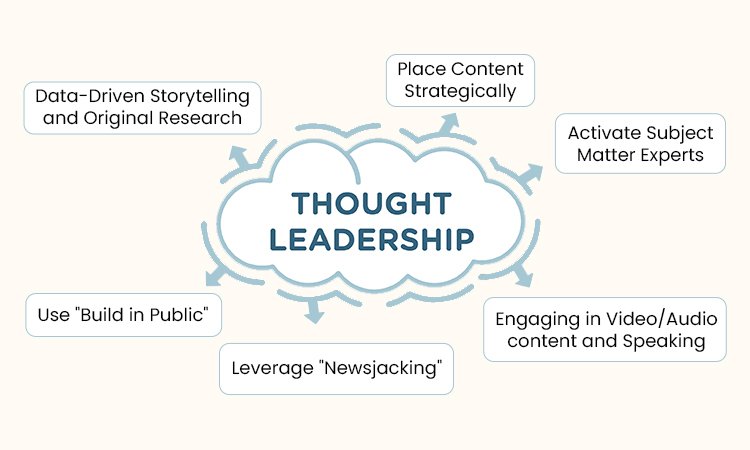
- Major Strategies to Establish Thought Leadership
Here are a few key tactics that SaaS businesses can use to establish thought leadership and ensure the success of their PR campaigns:
Strategy 1: Data-Driven Storytelling and Original Research
Journalists and industry professionals often prefer data that highlights the latest trends, unique industry insights, and industry benchmarks.
- Conduct Thorough Research: Survey your customer base and thoroughly evaluate specific product usage data in order to create comprehensive reports on industry challenges.
- Develop Benchmarking Studies: Offer valuable data that can allow competitors to compare themselves to industry standards.
- Publish Data-Driven Press Releases: Leverage the data obtained to secure media coverage in relevant and top-tier tech publications like Forbes and Crunchbase.
Strategy 2: Place Content Strategically
Strategically placing content is a major aspect of establishing thought leadership in SaaS PR.In order to position founders and executives as thought leaders,cloud-based software companies must publish bylined articles in various relevant industry publications rather than only on company blogs.
- Targeted Guest Posting: Identify publications that cover SaaS-specific niches (e.g., fintech sites), and pitch expert opinions on industry developments.
- Emphasize on “How-to” and “Why”: Offer actionable advice, solutions, and contrarian views to the industry solutions rather than product-specific marketing copy.
- Use Ghostwriters if Needed: Leverage experts to capture the unique voice of the founders and executives while maintaining a consistent publishing schedule.
Strategy 3: Activate Subject Matter Experts
Avoid relying solely on the CEO. By empowering Subject Matter Experts (SMEs) in engineering, products, and customer communication, Correct but repetitive with previous sentence. Could be shortened.
- Determine Internal Experts: SaaS businesses must find people who are deeply involved in the day-to-day, such as a lead engineer for AI topics or a Customer Support Lead for customer pain points.
- Story-Mining Sessions: SaaS businesses should conduct thorough sessions with Subject Matter Experts to gain unique perspectives and transform them into thought leadership pieces.
Strategy 4: Engaging in Video/Audio Content and Speaking
Thought leadership is increasingly moving toward video and audio formats, which help establish deeper trust.
- Launch a Company Podcast: SaaS businesses can start hosting a podcast to discuss the latest industry trends and interview other experts, positioning your SaaS company as a hub for industry knowledge.
- Appear as Guests on Podcasts: Pitch executives in order to appear on renowned niche podcasts, as these can offer easy access to a highly engaged and targeted audience.
- Speaking Opportunities: Secure panel positions or keynote slots at important events like Webby Awards or specialized industry summits.
Strategy 5: Use “Build in Public”
In the SaaS industry, authenticity is highly valued. This makes the “Build in Public” approach effective for small-scale SaaS companies.
- Share Lessons and Failures: SaaS companies must be very transparent about the company’s journey, including the major challenges in development or lessons learned. This can help foster trust and engagement on social media platforms like LinkedIn.
- LinkedIn Thought Leadership: Encourage leaders to post their original, personal perspectives on LinkedIn, sharing industry observations and company culture rather than just product announcements.
Strategy 6: Leverage “Newsjacking”
Reacting quickly to emerging trends and industry news helps capture attention even before the topic becomes saturated.
- Offer Expert Commentary: When a new regulatory shift or technology advancement happens, SaaS companies must instantly offer expert quotes and analysis to journalists.
Step 8: Monitor Performance with Relevant Metrics

You cannot determine whether or not your public relations efforts are working if you do not track the numbers.That is why an effective PR strategy should include clear tracking that is tied to growth.
It cannot be denied that monitoring traditional metrics such as impressions and media mentions still matter in 2026, but they are helpful only when paired with relevant SaaS metrics.
So, here are some of the KPIs KPIs (Key Performance Indicators)
of public relations that SaaS companies should be tracking, categorized by their business impact
- Revenue and Conversion Metrics
These metrics directly link PR activities to the revenue and sales pipeline, which is very important for justifying PR budgets.
- PR-driven leads: The number of Marketing Qualified Leads (MQLs) or Sales Qualified Leads (SQLs) that are generated directly from the earned media coverage. For example, users who have signed up after reading an article published on a tech publication.
- Referral Traffic and Conversion Rates: Leveraging UTM parameters on links within press releases or guest articles to determine how many visitors are driven to the website, and crucially, how many are converted into paying customers or trial users.
- Reduced Customer Acquisition Cost: This is one of the major metrics of SaaS PR that cloud-based software companies must track. Successful data-driven PR for SaaS should lead to a lower Customer Acquisition Cost (CAC) in comparison to paid ads by minimizing credible, third-party validation.
- Short Sales Cycles: This is the measure of whether or not the prospects who are engaging through earned media are moving through the sales funnel faster than those who are not.
- Brand Authority and Online Visibility
- Share of Voice (SoV): This is the percentage of media coverage that a brand receives in comparison to its top competitors. This metric showcases the amount of industry conversation the brand controls.
- Top-Tier Placement Volume: The number of articles in high-authority and target publications that influence target buyers and investors.
- Domain Authority: High-authority backlinks from public relations can enhance search engine optimization, organic traffic, and drive long-term growth.
- Sentiment and Reputation Metrics
- Sentiment Analysis: Determining the tone of social media mentions (Positive, Negative, and Neutral). High positive sentiment showcases that your public relations efforts are building credibility, while negative trends can be an early warning for reputation issues.
- Key Message Penetration: This qualitative metric measures whether journalists are using key, strategic messages to make sure the intended story is being told.
- Engagement and Content Performance
- Earned Media and Social Engagement: This metric is the measure of comments, shares, and interactions on articles that feature the brand. By tracking this metric, SaaS businesses can confirm that their content perfectly resonates with the audience.
- Earned Media Value: A valuable metric that estimates the cost of buying the same media space, helping to show financial ROI to leadership.
Major Do’s and Don’ts to Follow When Developing a SaaS PR Strategy
Public relations is a marketing strategy where even small mistakes can lead to serious consequences. So, here are some of the common do’s and don’ts SaaS companies must follow when developing a PR strategy.
- Do’s of SaaS Public Relations:
First, let’s discuss the do’s of SaaS public relations:
- Focus on Showcasing Benefits, Not Features
SaaS businesses must focus on showcasing the specific problems that their cloud-based software solves rather than focusing on the wide range of features it offers. For example, “Time-Saving” or “Offers Higher ROI.”
- Practice and Ace “Newsjacking”
Newsjacking is all about inserting your brand into breaking news to enhance visibility. SaaS businesses must connect their brand to trending industry topics, regulations, or news in order to stay relevant.
- Target Niche-Specific Media
Targeting niche-specific media is very important to ensure effective SaaS public relations. Pitch to journalists who specifically cover SaaS-related stories in order to ensure your story reaches the right audience.
- Leverage a “Digital First” Approach
Implement AI-powered tools such as Brand24 and PressPal.ai in order to identify relevant journalists, optimize for AI-generated search results (Generative Engine Optimization), and track sentiment.
- Don’ts of SaaS PR
- Relying Solely on Press Releases
This is one of the major mistakes of SaaS PR that cloud-based companies often make. Sending frequent, generic press releases to journalists can frustrate them, reducing the chances of your story being covered. Rather than sending frequent, complicated, or overly salesy press releases, SaaS companies must send brief press releases that focus on the benefits of their products or services rather than simply the features.
- Creating Vague or Shady Messaging
Many SaaS companies often make this mistake. Cloud-based software companies must avoid making false promises when developing their messaging. If SaaS companies leverage “Shady” PR messaging, it might lead to long-term reputational damage, high customer churn, and prospective legal action.
- Ignoring Customer Support and Feedback
Customer reviews and feedback are very important in the SaaS space. Customers often look for genuine experiences from other users before deciding whether they should invest in a particular SaaS product.. In fact, 55% of customers say that a business responding to reviews matters to them. When a SaaS company fails or ignores negative feedback, it can severely damage its reputation. Remember, customer dissatisfaction can turn into a PR crisis in no time.
- Being “Short-Sighted”
Public relations is an ongoing process. SaaS companies must not expect instant, massive results from just a single PR campaign. Rather, SaaS brands must stay consistent in order to raise awareness.
FAQs
Ans. Yes, incorporating PR is crucial for an early-stage SaaS startup, but it should be approached as a strategic and often in-house effort rather than a high-cost agency campaign.
Ans. Yes, a large-scale SaaS company still needs press releases in 2026. However, their purpose has shifted from simply generating media buzz to serving as a foundational component of SEO, digital authority, and trust building.
Ans. Public relations for SaaS businesses focuses on data-driven, digital-first, and niche B2B strategies to establish credibility, product-driven authority, and backlinks rather than relying solely on broad brand awareness through broadcast and print media.
Ans. Earning high-quality PR backlinks for a SaaS company includes data-driven, link-worthy content creation, leveraging expert HARO or reactive pitching, and securing guest posts on high DA websites.
Ans. Some of the must-have public relations tools for SaaS companies are MuckRack, which is ideal for journalist targeting, Prowly, which helps with AI-powered press release distribution, and BuzzSumo to determine the latest trends.
Ans. SaaS companies can partner with PR professionals when their product has achieved product-market fit and is ready to scale. Especially when planning crucial milestones like product launches, funding rounds, or expansion into new markets.
Ans. SaaS PR agencies help software companies build credibility, growth, and brand awareness by creating engaging narratives that directly translate technical features into long-term business impact.
Conclusion
Effective SaaS PR is vital for the growth and success of any SaaS company. By developing a unique brand voice, fostering robust media relationships, and creating valuable content, SaaS businesses can establish a powerful public relations strategy that can drive results. However, follow the key do’s and don’ts in order to ensure a successful public relations effort. In case you are just starting out and have no idea how to proceed with public relations, then you can perhaps partner with an experiencedpublic relations agency.
